
Meat Computer, Meet Computer
An interaction I hope I'm not around for...

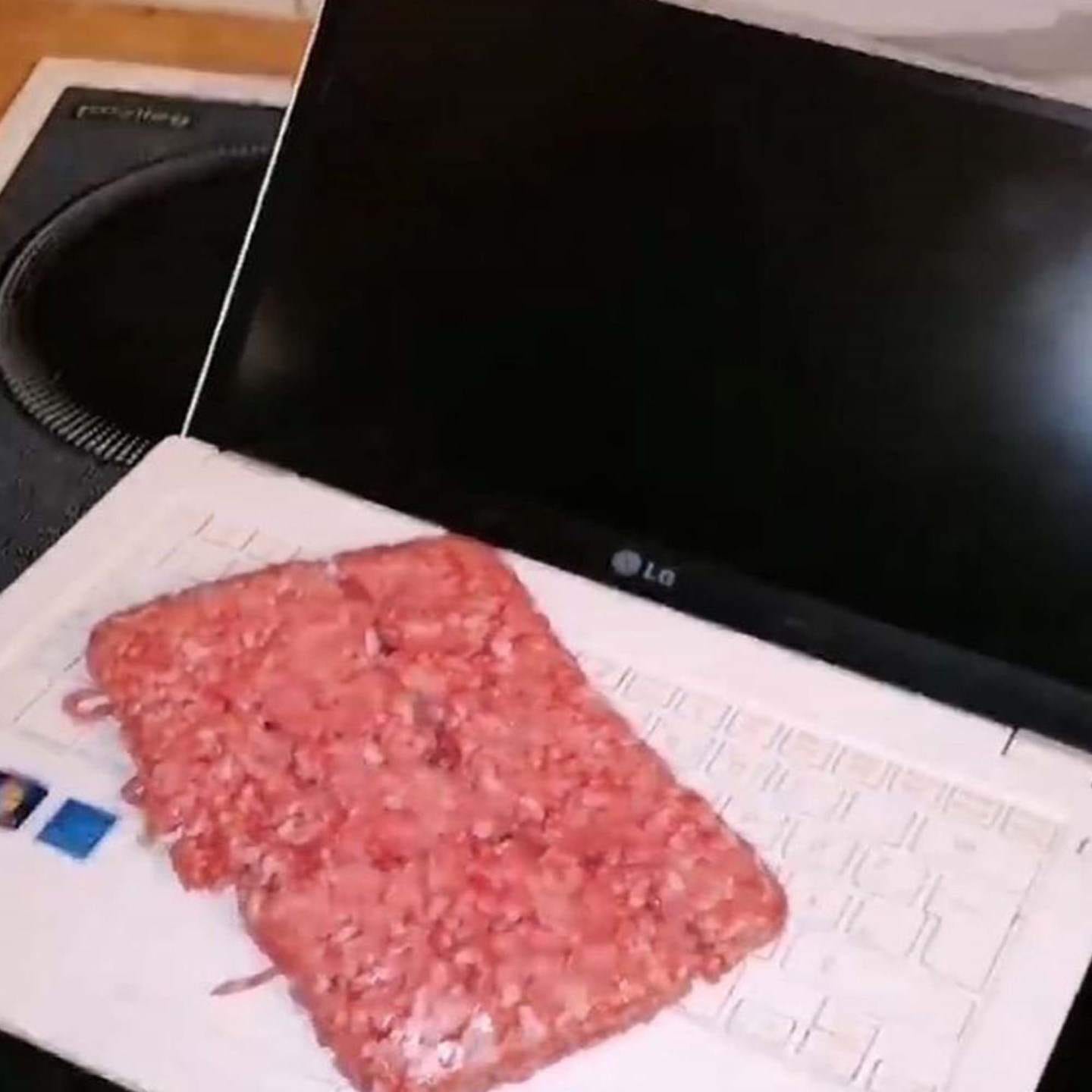
@ 1:12
I know you now
I’ve felt you out
That night we shared that glass of wine
We spilled ourselves on the floor for both to see
Now nothing can change that day for you and me
Cause I’ve offered you my heart out showed you what I’m made of
I sat at the piano and my fingers went to work
I’ve never felt so hurt
My voice was so unheard that night we shared that glass of wine
meat computer.
I think if I had written this a few weeks ago, I would’ve only included the line “meat computer.” The song above, Stray, is by popular hyperpop artist meat computer. They use a producer tag before some of their beat drops, where a heavily autotuned voice utters their name. I don’t know why hearing that voice say “meat computer” has always been so satisfying to me, but it’s honestly why I listen to their music.
I’m a neuroscience student. If you haven’t made the connection already, then here it is. I’m studying meat computers for the next four years. Unfortunately, “meat computer” will most likely be a synonym for “brain” for the rest of my time on the planet. A week ago, I sat through a lecture on the body’s nervous system, and my professor (also the head of the neuroscience department) asked everyone to draw a neuron in our notes. She then walked around the class, inspecting everyone’s drawings. I had drawn a very pretty neuron, but I had also previously written “MEAT COMPUTER” at the top of my page in fat block letters. My professor inspected my page, seemingly without much concern since my neuron looked satisfactory. There was, however, a slight hesitation in her gaze. A pause in her flow that forced out a barely audible “hm” from her pursed lips.
I knew that she had registered the words “meat computer.”
I can’t explain why, but the phrase has a way of sticking in your head. I hope it’s stuck in my professor’s head, a memory that appears randomly in her head. Like, “Meat computer, that’s what Tom (I don’t know why she calls me this nobody ever calls me that) wrote in his notes. Ignoring its gross connotations, it’s a genius name for a band. Iconic, in a way. By now, I’ve written “meat computer” in this post more than you or I would like, so I’ll stop (for now).
I’ve never been one to pay much attention to lyrics; I usually focus more on the instruments and rhythm. For me, lyrics usually turn into sounds, making up the melody. Despite this, after repeatedly listening to a song, the lyrics themselves get harder to tune out. After listening to Stray countless times, the lyrics I included at the beginning of this post popped out at me. Compared to other songs of the hyperpop genre, I think these are above average. I’ll save you the bore of reading me psychoanalyze each and every line (I’m also just too lazy to do this), as I’m sure you could do so yourself, given the fact that the lyrics are basically just telling a story. Feel free to scroll back up and read them again.
What I love most about this story is that it completely omits how the narrator got hurt; it just provides the fact that they did as a given. The final line alludes to why things went wrong with this person, “My voice was so unheard that night we shared that glass of wine.” I love this because it contrasts what might’ve seemed like a mutual situation at the story's start, with both “spilling” themselves on the floor.
“Spill” involves a sort of involuntary connotation that I particularly relate to. I often find that once I tell someone one personal thing, everything else just sort of, spills out. In spilling myself out, I often find that I can “speed run” getting closer to that person. Oversharing deep and personal secrets about myself enables a chemistry that most relationships take weeks, if not months, to reach. I’d love to write more about this topic because of its pros and cons, but for now, I just want to focus on the fact that I do it at all. There’s nothing inherently wrong or right about it, and I don’t do it consciously, but it is something I like to keep track of.
I think it took me a while to realize that friendships, or romance, that start with the “spilling” of yourself are not absolved from the same problems that every relationship has the potential to run into. In fact, it's even worse because the stakes are higher, and the potential for people to get hurt increases with the amount that those people know about you. At the same time, the liability of getting hurt still exists when someone finds out something they didn’t know about you later in the relationship’s progress. In Stray’s story, though, the characters choose to spill themselves, resulting in the narrator being hurt, presumably because things did not work out between them and the person they spilled with. I want to focus on the logical disconnect in that they knew everything about each other, but the narrator still felt “unheard.”
I hope you enjoyed that break because I’m going to start using the phrase “meat computer” again. Due to my planned neuroscience degree, and my disdain for attending medical school, I will most likely end up doing some form of artificial intelligence or machine learning work. That or data science, which is a little bleak but would pay the bills anyhow. Career prospects aside, the difference between the human brain and an artificial brain is something that I enjoy thinking about. Computers are reaching a point where it seems like there aren’t many things they can’t do. While this thought freaks me out, at least one thing that people seem to agree is beyond the scope of computers, and that is emotion. I think a lot of this boils down to how emotions are inherently illogical, and how our “meat computers” react to those emotions in inexplicable ways.
Learning to appreciate this fact is something that I struggle with. My brain likes logic, despite my occasional failure to see logic, which separates my brain from being a computer itself. What I noticed in the lyrics of Stray is that despite one person knowing seemingly everything about you, a part of you still goes unheard. There is still a voice that is not given a platform, even if you say everything you possibly can. The way that our personalities cannot be handed to someone in a text file is an equal parts frustrating and beautiful part of meat computers. There is something that cannot be explained about ourselves with words, or logic, which further solidifies the separation between us and computers. I find much comfort in this fact.
The problem I realize now boils down to an issue of pigeonholing. I think there is an emotional aspect of myself that wants to be understood and validated the first day I meet someone. However, due to the inability of our “meat computers” to be easily summed up, it’s impossible for this “spilling” of myself to effectively communicate my entire being, no matter how hard I might try. As a result, I end up convincing myself and others that the person I share upon the first spill is in fact my complete being, effectively boxing myself into that character. It leaves little room for growth and little room for error as well.
Sometimes I wish to simply hand my personality to someone in a packet of code because it would be so indulgently easy. I’m learning to appreciate, though, that the process of getting to know someone is equally as satisfying as the feeling of knowing, or being known. Maybe what I’m trying to say is that knowing someone “fully” is only rewarding when you’ve actually put in the work to do so. I think that if I were to meet someone whom I could genuinely grasp in only a few hours, I would become bored within a few weeks (at most).
I love pointing out little intricacies that separate us from computers because many of them are easy to forget. It’s even easier to forget that given the current impossibility of computers replicating ourselves, it is equally impossible for us to replicate computers. The simplicity and logic of a computer are undeniably attractive to the human mind, but if we were to remove our own complexity, I think I would miss it. A lot.
“You know that’s not what I meant. You know me; you know my being,” I said.
“Ha-ha. Yes. I do ‘know your being’,” they responded.
It was so satisfying. There is always more to know, but I can’t explain how satisfying that was to hear.
Thomas