“THIS IS SO MADELINE,” I said to myself, over and over again. I’ve spent the last few weeks attempting to write about being in my “Madeline Era,” studying in a situation similar to a boarding school, away from my family for extended periods of time. The problem I ran into was that the similarities between Madeline and myself inevitably dissolved after enough thought. Let me just say, I am very tired of thinking about Madeline. She has cursed me with her wholesome spunk and her unbreakable spirit. Ultimately, it was disappointing to realize that I’m not a beloved children’s book character. I’m not in a “Madeline Era.” I’m just in college.
Reapproaching Madeline, as both a book series and a tv anthology, was indulgently nostalgic. I wish I had appreciated its purity 12 years ago the way I do now. It’s rare to see a series that radiates such irrefutable positivity. If I had tried to write Madeline, it would have turned into a Mean Girls spin-off. I’m hopeful that more content takes a more Madeline approach overall. It’s hard to ascribe a theme, or analysis, to the entire universe that is Madeline’s, and I’m not going to try. The best I can think of would be positivity, or maybe love.
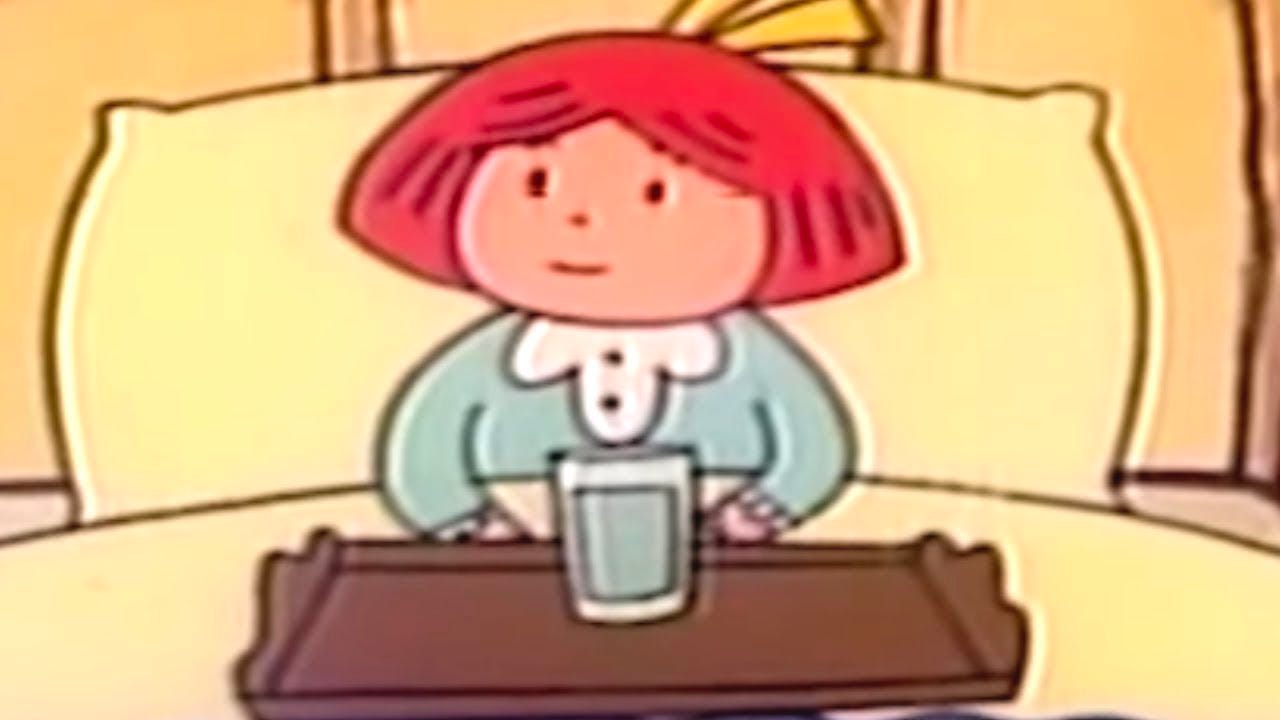
The part of Madeline that you might remember is the iconic appendicitis episode. That, and the yellow raincoats. Maybe some of the songs, too. When Madeline gets appendicitis, she’s taken to the hospital and has her appendix removed. During this time, the rest of the girls at the boarding school are in complete disarray. All they want is for her to come back and for her to be okay. When they are allowed to visit Madeline, they spend an entire day searching for the perfect gifts to help her feel better. They treat her so well that they convince themselves they should fake appendicitis to end up in the cushy hospital with Madeline.
I saw a parallel between Madeline and myself when I got the flu this past semester. I unapologetically turn into a wounded, whining mess when I get sick. My parents usually picked up the slack, and now it would be my friends. Everybody enters college with varying levels of independence, but it’s all equalized by how you respond to challenge. As much as I like being independent, I have learned to love the makeshift “family” that college creates. The flu completely incapacitated me, and my friends responded by sending me gifts of care and well wishes. From friends, it could be considered the bare minimum. It depends on how high your friendship standards are, I guess. I found it incredibly touching.
Bare minimum or flatteringly generous, it all derives from the same central feeling that compelled Madeline’s friends to visit her in the hospital. For a split second, regardless of the world’s external stresses, there existed a chasm where I could be Madeline, and my friends her friends. The life transition of becoming a college student is supposed to represent the beginning of independent adult life. What I’ve realized, though, is that my college situation lends itself to a wholesome amount of care and love comparable to the love I received back home, growing up. My friends and I are forced to look out for each other because we realize, at a physical level, no one else is doing so. In this way, we can touch on an inner purity similar to one that many of us yearn to have back.
Madeline, Madeline, Madeline.
Much of my creative time has been spent discussing the transition from childhood to adulthood. One of my screenplays, Anywhere But Here, features the regret of chasing adulthood as a central theme. Despite this, it has taken me until now to realize that growing up can mean more than simply becoming an adult. College life has allowed me an opportunity to grow up again, just in a different way. I may be an adult, but it feels like now is when we are finally learning how to live. It’s an amorphous yet invaluable education. It’s unlikely that we will see life with the same wonder that Madeline does, ever again. However, there are tiny moments that allow me to recognize that the end of childhood does not mean the end of purity, or wholesomeness. I’m grateful for that, and I’m grateful for the friends that make that statement true. We are all adults who are learning how to be adults, and in that shared struggle, there is a relatability similar to those children who yearned to be where we are now.
If you think about growing up in the right way, you never stop growing up. There is always more to learn, and there is always more beauty to be found. A close friend of mine called me recently. I’ve known him since preschool. He asked me, “Is it too late to be kind?” I was shocked by this question because it was unorthodox compared to our usual conversations. I responded by telling him, no, it wasn’t too late to be kind. It’s never too late to be a kind person.
There is always more.
When I was in second grade, my favorite part of class was when we would go to the computer lab. I loved playing games on the old Macs they kept there. Mr. Nick oversaw the school computer lab, and I consider him one of the first adult mentors I ever had. He recognized my computer proficiency and rewarded me with new challenges and opportunities. I looked up to him quite a lot. When I left elementary school, he handed me a letter. He wrote to me,
“When I grow up, I want to be like you.”
The feeling of being in fifth grade and having your teacher say they wanted to be like you is kind of indescribable. I remember feeling happy and loved, but I was also baffled. Why on earth did he want to be like me? It should have been the opposite. To this day, I don’t know exactly what he saw in me that compelled him to write that. I am beginning to realize that Mr. Nick, despite being an adult with a full-time job, still recognized that there was room for him to grow up. Through this lens, what he said makes a little more sense. When I grow up, I think I want to be like Madeline.
There is always more.
I have now challenged myself with the notion that none of us ever finish growing up, and in that continued state of growth, there is an opportunity to recover the wholesome nature that many of us lose over time. It means that I will never be done interpreting the meaning of “growing up,” and I’m learning to recognize that it’s a privilege, not a curse. Being a grown-up does not signify the end of growth. I am incredibly blessed to live in a situation where life always provides me with more room to grow.
To feel and learn how to feel. To love and learn how to love.